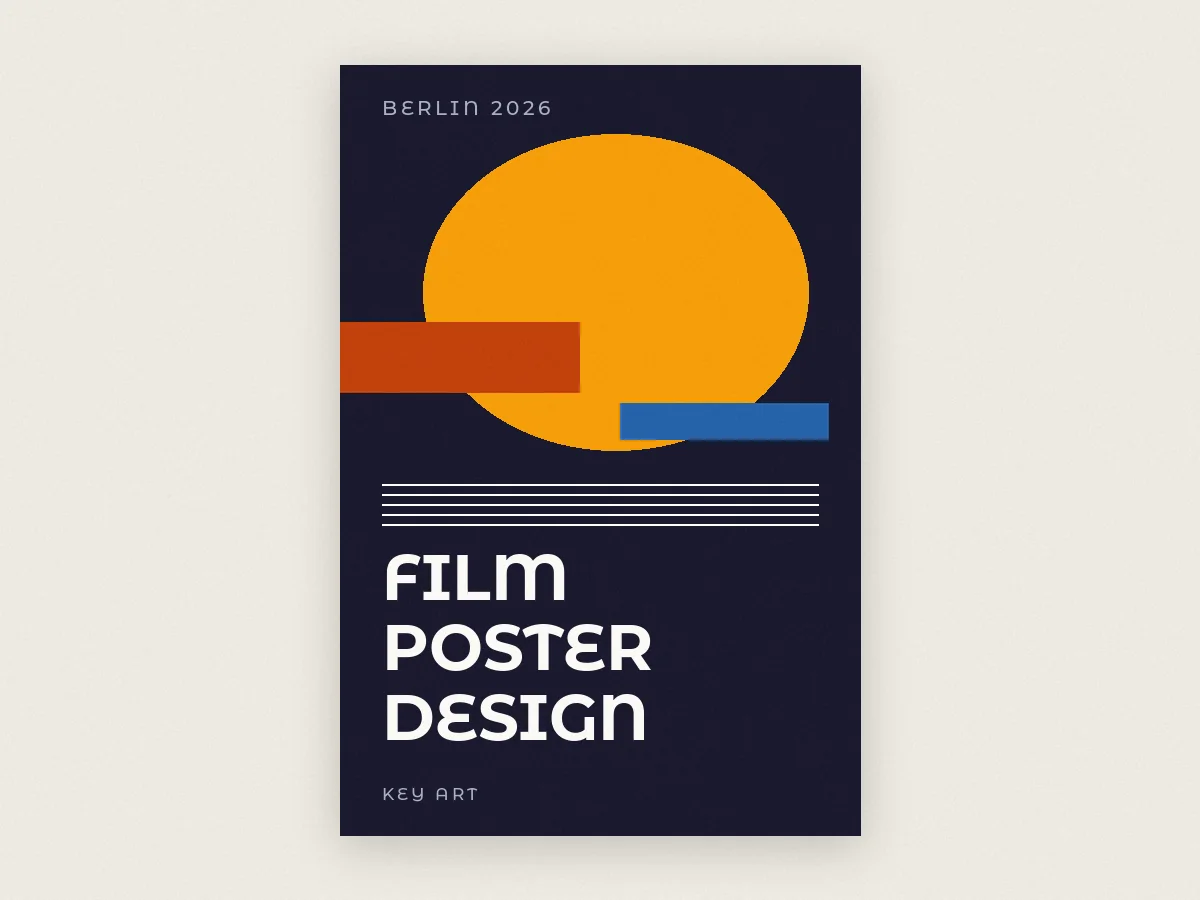
Film Poster Design for Independent Cinema
A film poster is often the first thing an audience sees, usually before the trailer and the reviews. For indie films, short films and festival submissions it has to carry a lot: mood, genre and the world of the film, in one image.
Each project starts with the film itself: its tone, its themes and the feeling it leaves behind. The design then moves through image direction, type selection and layout to final execution in Adobe Photoshop, with other Creative Cloud apps where needed. Typeface, palette and text placement are each chosen for the film in question.
Story, genre, tone and audience come first. The visual direction and key image concept are set before any design work starts.
Selecting or directing the key image, defining the typography system (font, weight, size, colour, placement) and establishing the full colour palette.
Final poster assembly in Photoshop, including gradient work, layer blending, the billing block and all typographic elements, delivered print and web ready.
Robogamy: AI, trust and the future of love
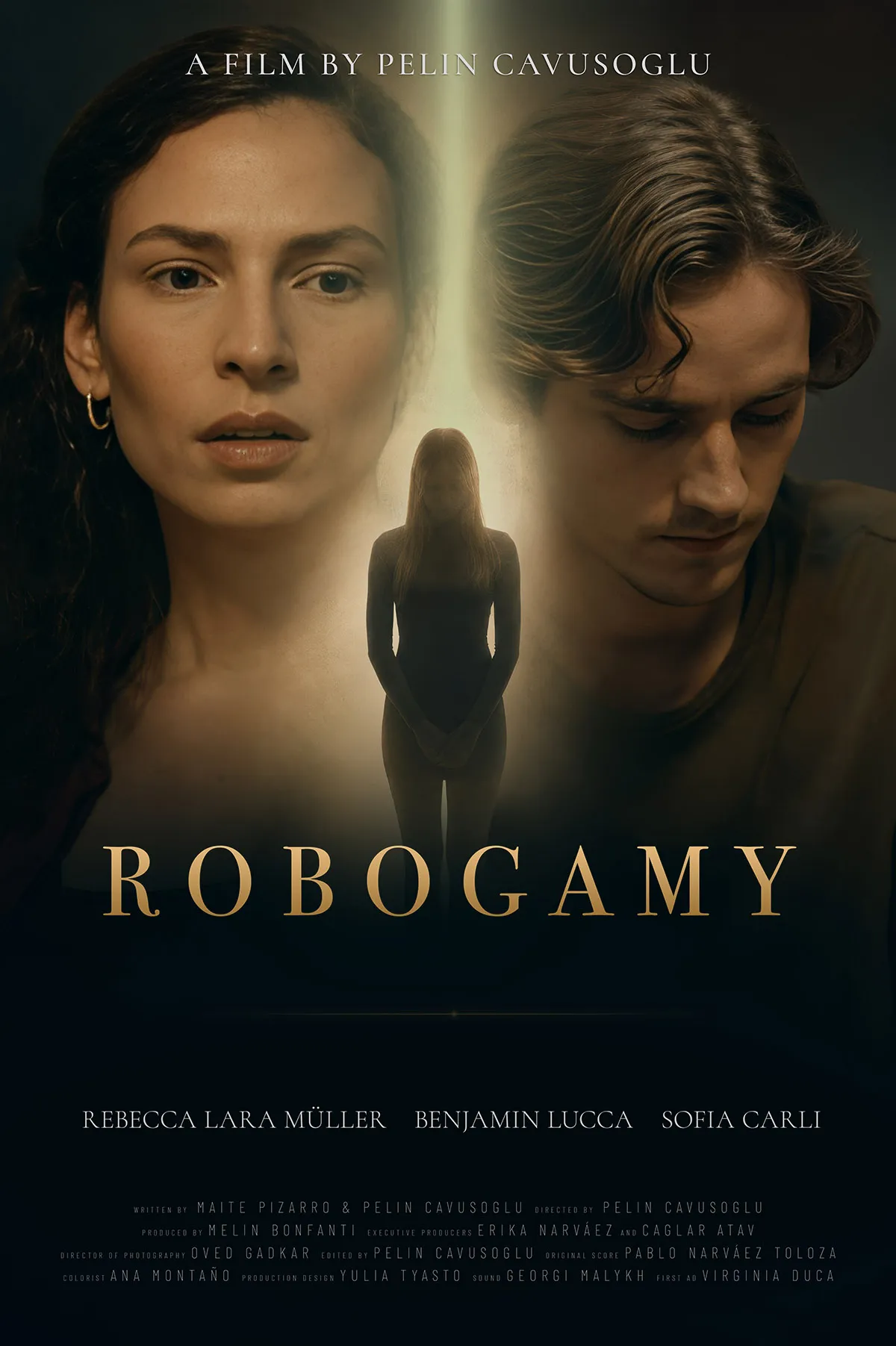
Robogamy film poster · Adobe Photoshop
Robogamy explores trust, jealousy and emotional dependency in an age where artificial intelligence is becoming increasingly present in everyday life. As a couple prepares for marriage, a seemingly simple test of loyalty evolves into a confrontation with questions of control, surveillance and the nature of intimacy itself. Through this near-future scenario, the film asks how new technology may reshape relationships and change how people love and trust.
Cold sci-fi dread with a human core
Robogamy is intimate and technological at once, emotionally warm and visually cold, and the poster had to hold both. The design leans into the near-future tension of the story: a clinical, digital palette, type with a quiet sense of surveillance, and a composition in which the people are present but observed. The aim was a poster that sits comfortably in a festival programme next to serious science fiction.
The typography is precise and slightly cold. It suggests systems, monitoring and control while staying clear of sci-fi clichés. Colour grading on the key image was pushed toward desaturated blues and cool neutrals to reinforce the near-future setting. The billing block follows the usual film-poster layout, so the poster reads as a professional release.
Working with Pelin Cavusoglu
Robogamy is directed by Pelin Cavusoglu, a Berlin-based director, filmmaker and videographer Pelin knew from the start what the film needed to feel like, and that made every design decision easier. Thank you, Pelin. It was a pleasure from start to finish.
Visit pelincavusoglu.comLongitude of Grief: a poetic road film poster
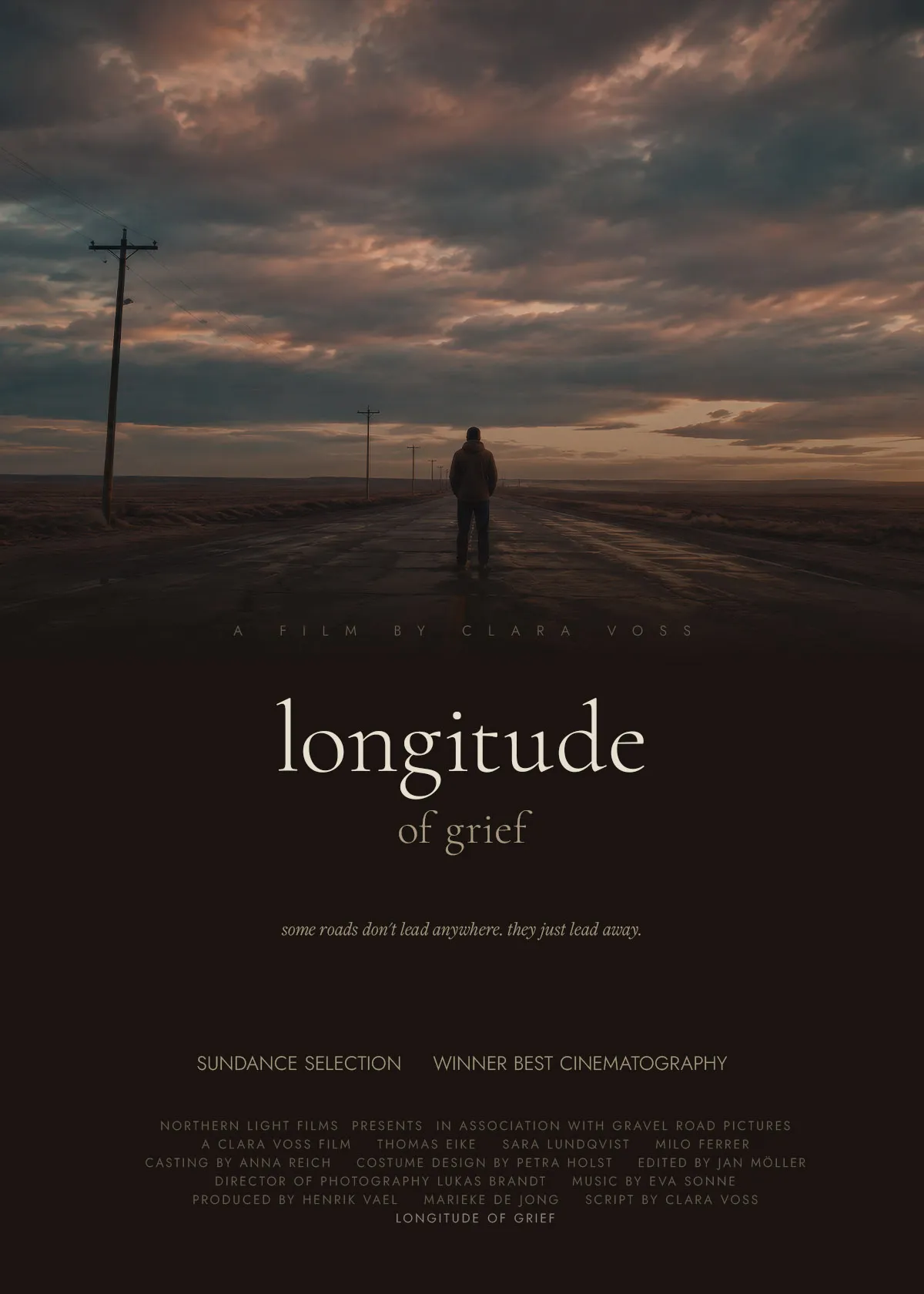
Longitude of Grief film poster · Adobe Photoshop · Freight Display Pro
Longitude of Grief is a poster concept for an imagined road film: a quiet, devastating story about a man who walks away from everything he knew, with no destination in mind. Set across the flat plains of the American Midwest, the story follows one week of solitary driving, chance encounters, and the slow realisation that distance from pain is not the same as healing. A film about the geography of loss.
Dramatic atmosphere through light, scale and restraint
The poster is built around one idea: making the viewer feel small. The key image was directed to place a lone figure against an enormous, bruised sky: a vast flat landscape with telegraph poles disappearing into the distance. The figure takes up about 5% of the frame, and the empty space around it carries the mood. The lighting, golden hour desaturated to near-grey, does the emotional work before a word is read. Typography in Freight Display Pro Book Italic was chosen for its quiet elegance: lowercase, slightly broken, like a person who has run out of the energy to shout.
The palette has no pure black or white. All tones are warm browns, bone whites and faded gold, matching the drained mood of the image. The title splits across two lines: "longitude" large in warm bone white, "of grief" smaller in faded gold below. The title steps down in size like an exhale. A dark gradient dissolves the road into the text zone, so image and type read as one surface.
- AI-assisted key image generation with custom cinematic prompt direction
- Full poster layout and composition in Adobe Photoshop
- Custom gradient work to blend the image into the text zone
- Typography: Freight Display Pro (Adobe Fonts) and Jost (Google Fonts)
- Complete billing block in the usual film-poster layout
- Delivered at 1200 × 1680 px, optimised for web display
The Pale Geometry: a cerebral horror film poster
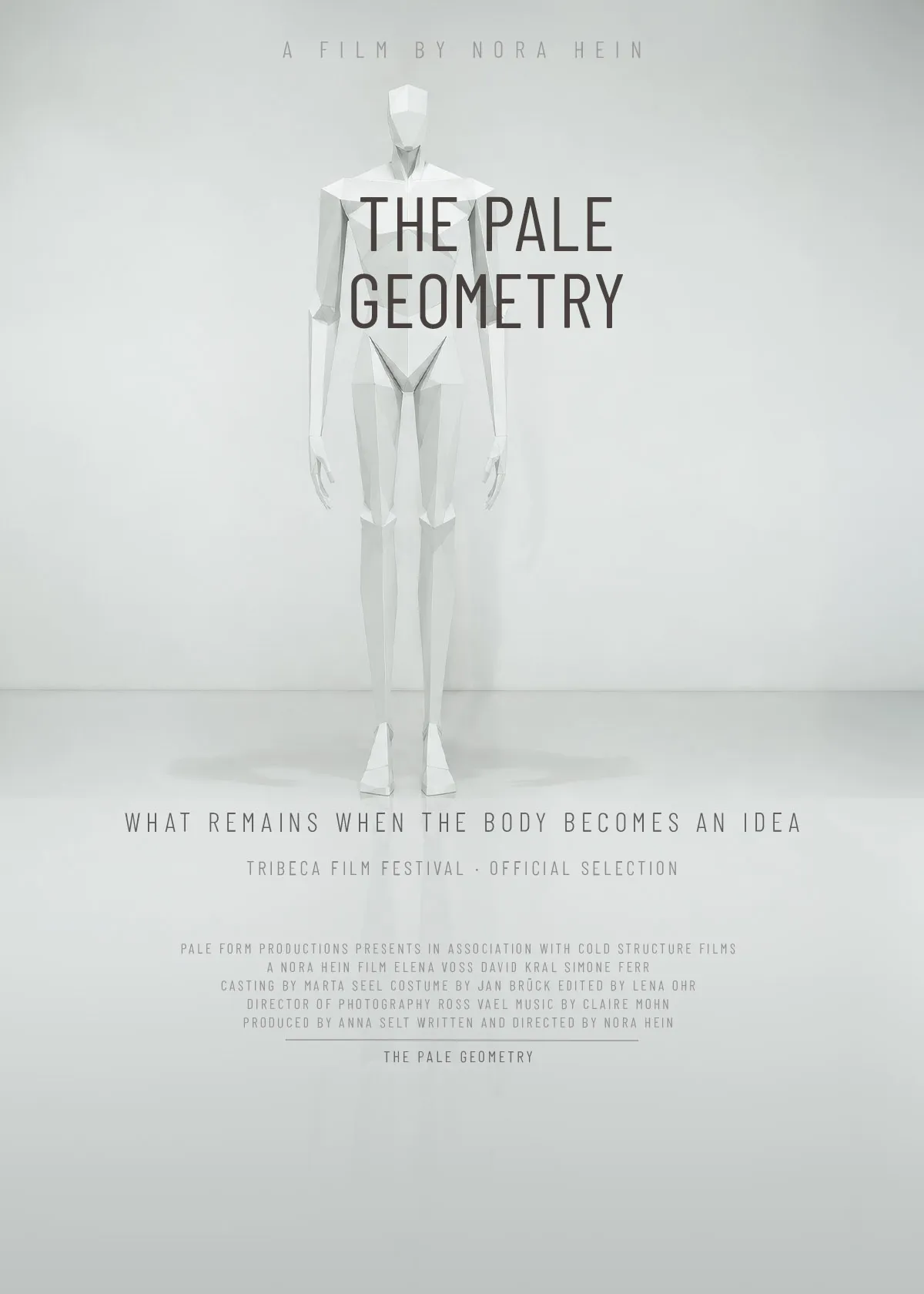
The Pale Geometry film poster · Adobe Photoshop · Barlow Condensed
The Pale Geometry is a poster concept for an imagined body horror film with no blood. A woman wakes to find her body slowly reorganising itself into geometric forms: joints becoming angles, flesh becoming planes. Doctors find nothing wrong, and the scans are clean, yet the mirror keeps showing the change. A film about dissociation, identity and the terror of turning into a shape. Cold, clinical and unsettling, with the horror coming from things being subtly wrong.
Uncanny feeling through clinical precision
This poster had to look like a medical file that had become aware of itself. The film finds its horror in things being slightly, wrongly off, and the design does the same. A full-bleed white clinical room. A geometric figure that is almost human. Type in Barlow Condensed set directly over the figure's torso, merging with the body, so the title occupies the figure. The slight asymmetry between figure and type is deliberate: in a poster this controlled, anything misaligned reads as a symptom.
Red on white is the obvious horror choice. It was rejected. Red announces danger. This film's horror is quieter and creeps up on the viewer. Near-black type on clinical white is more unsettling because it looks like documentation. The title colour, #1C1410, is a near-black with a faint warmth, like something organic trying to look neutral.
- AI-assisted key image generation with revised prompt to achieve a clinical geometric aesthetic
- Full poster layout and composition in Adobe Photoshop
- Full-bleed white treatment with no gradient and no dark zone, so the text sits directly on the image
- Typography: Barlow Condensed (Google Fonts), with weight refined from Bold to Regular for uncanny fragility
- Complete billing block in the usual film-poster layout
- Delivered at 1200 × 1680 px, optimised for web display
What the film poster design service includes
Every poster is a complete piece of key art, from the first concept to a delivery-ready file, for a festival submission, an online release or a full campaign.
- Brief and film review: understanding your story, tone, genre and target audience
- Key image direction: working with your existing stills, or prompting and generating a custom image
- Full typography system: font selection, hierarchy, size, colour and placement
- Colour palette definition, harmonised with the image and emotional tone of the film
- Composition and layout in Adobe Photoshop: gradient work, layer blending, text zones
- Billing block: cast, crew, production company and awards line in the usual film-poster layout
- Tagline copywriting if needed
- Delivery in web-optimised and high-resolution print-ready formats
- International versions of the poster in other languages, including right-to-left and CJK scripts
Film posters for international festivals and distribution
When a film travels to festivals abroad or is picked up by a distributor in another country, the poster travels with it, and the text on it has to change. That is where many posters break down. A translated title rarely fits the space the original was designed for: German and French titles often run longer, Arabic and Hebrew read right to left, and Chinese or Japanese titles need different typefaces and line breaking.
The title is rebuilt for each language, so the typographic idea behind the original survives the translation.
Credits and tagline are set in the target language while keeping the hierarchy and legibility of the original design.
Arabic, Hebrew, Chinese, Japanese and Korean versions use fonts that fully support the script, with correct text direction and line breaking.
This is the same discipline behind multilingual DTP: text expansion, script-specific typography and consistent files across every language version. Translations come from your translators or distributor. The layout of each version is handled here and delivered in the same web and print formats as the original.
Mention it when the original poster is designed. Leaving room in the title zone and choosing a typeface family that also covers the target scripts makes every later language version faster and cheaper to produce.
Related services and projects
Have a film that needs a poster?
Short film, indie feature, festival submission or international release, with versions in every language the film needs. Send a synopsis and any stills you have. The first look is free.
Send your film details →